Essa é uma pergunta que recebo com frequência, e neste episódio vou respondê-la da forma mais simples, direta e eficiente possível. (This is a question I get often, and in this episode I’m going to answer it in the simplest, most direct, and most efficient way possible.)
Você vai encontrar um passo a passo de estudo para melhorar seu português: compreensão auditiva, leitura, vocabulário e resumo.(You’ll find a step-by-step study plan to improve your Portuguese: listening comprehension, reading, vocabulary, and summary.)
Tem também um presente que preparei para você! Um PDF disponível para download, com exercícios para praticar e treinar seu português!
Hoje temos uma história especial para você: uma lenda indígena brasileira cheia de magia e emoção. 🌿Today we have a special story for you: a Brazilian indigenous legend full of magic and emotion.
Vem comigo ouvir e ler essa lenda enquanto aprende português de um jeito leve e divertido.Come along with me to listen to and read this legend while learning Portuguese in a light and fun way.
The Legend of Guaraná - Short Stories in Portuguese
A Lenda do Guaraná
The Legend of Guaraná
Try reading the following story aloud:
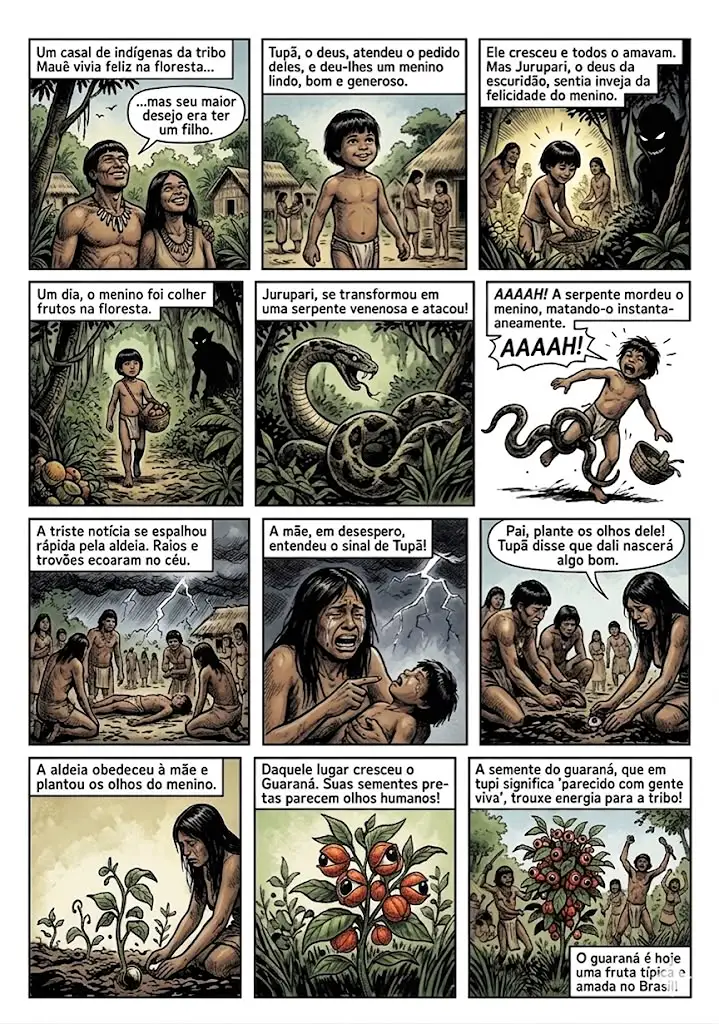
Um (1) casal de indígenas, que faz parte da tribo Maués, vivia junto por muitos anos sem ter filhos, mas desejava muito um dia ter uma criança.
Então, um dia eles pediram a Tupã para dar a eles uma criança para completar a felicidade do casal. Tupã, o rei dos deuses, sabendo que o casal era (2) bondoso, (3) lhes atendeu o desejo, dando a eles um lindo menino.
O tempo passou rapidamente e o menino cresceu bonito, (4) generoso e bom. No entanto, Jurupari, o deus da (5) escuridão, sentia uma extrema (6) inveja do menino e da paz e felicidade que ele transmitia, e decidiu (7) ceifar aquela vida em flor.
Um dia, o menino foi pegar frutos na floresta e Jurupari se aproveitou da ocasião para (8) lançar sua vingança. Ele se transformou em uma serpente venenosa e mordeu o menino, matando-o (9) instantaneamente.
A triste notícia (10) se espalhou rapidamente. Neste momento, (11) trovões ecoaram e (12) fortes relâmpagos caíram pela aldeia. A mãe, que chorava em desespero, entendeu que os trovões eram uma mensagem do Tupã, dizendo que ela deveria plantar os olhos da criança e que deles uma nova planta cresceria dando saborosos frutos.
Os índios obedeceram aos pedidos da mãe e plantaram os olhos do menino. Nesse lugar cresceu o guaraná, (13) cujas (14) sementes são negras e (15) possuem uma pequena parte branca ao redor, imitando os olhos humanos. Os indígenas deram-lhe(16) o nome de guaraná, o que significa “parecido com gente viva”.
Vocabulary from the Short Story in Brazilian Portuguese:
Expand your vocabulary! Make sure you know the most important vocabulary words for understanding the story!
1.casal:casal é formado por duas pessoas que gostam uma da outra e vivem juntas ou mantêm um relacionamento. (A couple is formed by two people who like each other and live together or maintain a relationship.)
2.bondoso: uma pessoa bondosa é alguém que ajuda os outros e é boa com as pessoas. (A kindperson is someone who helps others and is good to people.)
3. lhes:pronome que se refere ao casal no texto, significa para eles, para o casal. (A pronounthat refers to the couple in the text, meaning “to them,” “to the couple.”)
4. generoso: generoso é alguém que gosta de ajudar, dividir o que tem e fazer coisas boas pelos outros. Sinônimos: bondoso, bom.(Generousis someone who likes to help, share what they have, and do good things for others. Synonyms: kind, good.))
5. escuridão:escuridão é quando não tem luz e tudo fica escuro.(Darknessis when there is no light and everything becomes dark.)
6.inveja: inveja é o sentimento de querer ter o que outra pessoa tem ou desejar ser como é uma pessoa, ter a vida como a de outra pessoa.(Envyis the feeling of wanting to have what another person has, or wishing to be like someone else, to have a life like another person’s.)
7. ceifar aquela vida em flor: ceifar é um verbo que não é muito usado na comunicação, significa cortar. Cortar aquela vida em flor significa na história, matar; cortar uma vida que está se tornando uma flor.(“Ceifar aquela vida em flor” (to cut short that life in bloom): “ceifar” is a verb not commonly used in everyday speech, meaning “to cut.” In the story, cutting that life in bloom means to kill; to cut short a life that is blossoming.)
8.lançar sua vingança:significa colocar em prática a vontade de fazer mal a uma pessoa. (To unleash one’s revenge means to put into practice the desire to harm someone.)
9. matando-o:o menino.(Killing him:the boy.))
10. se espalhou: chegou a muitas pessoas. Significar: distribuir, ampliar, propagar.(Spread:reached many people. Meaning: to distribute, expand, propagate.)
11. trovões ecoaram:“Trovões ecoaram” quer dizer que os trovões fizeram um barulho forte e foi ouvido fortemente por vários lugares.(“Thunder echoed” means that the thunder made a loud noise that was heard strongly in various places.)
12. relâmpagos: fortes relâmpagos são luzes muito fortes que surgem no céu quando está chovendo.(Lightning bolts:strong lightning bolts are very bright lights that appear in the sky when it is raining.)
13. cujas:que tem, de que. “O guaraná, cujas sementes são negras…” → O guaraná que tem sementes negras. Em inglês: whose.(“Cujas”:which has, of which. “The guaraná, whose seeds are black…” → The guaraná that has black seeds. In English: whose.)
14. semente(s): é a parte da planta que pode dar origem a uma nova planta.(Seed(s):the part of the plant that can give rise to a new plant.)
15. possuem: têm. “As sementes possuem uma parte branca ao redor.” → As sementes têm uma parte branca ao redor.(“Possuem”: have. “The seeds possess a white part around them.” → The seeds have a white part around them.)
16. lhe:a ela, a árvore, ao guaraná.(“Lhe”: to it, to the tree, to the guaraná.)
Short Story in Portuguese with an English translation
Now read the story with the English translation!
Um (1)casal de indígenas, que faz parte da triboMaués, vivia junto por muitos anos sem ter filhos, mas desejava muito um dia ter umacriança. (A coupleof indigenous people, who were part of the Mauéstribe, lived together for many years without having children, but wished very much one day to have a child.)
Então, um dia eles pediram aTupã para dar a eles uma criança paracompletar a felicidade do casal. (So, one day they asked Tupãto give them a child to complete the couple’s happiness.)
Tupã, o rei dos deuses, sabendo que o casal era (2)bondoso, (3) lhesatendeu o desejo, dando a eles um lindo menino. (Tupã, the king of the gods, knowing that the couple was kind, granted theirwish, giving them a beautiful boy.)
O tempo passou rapidamente e o menino cresceu bonito, (4) generosoe bom. (Time passed quickly, and the boy grew up handsome, generous, and good.)
No entanto, Jurupari, o deus da (5) escuridão, sentia uma extrema (6) invejado menino e da paz e felicidade que ele transmitia, e decidiu (7) ceifar aquela vida em flor.(However, Jurupari, the god of darkness, felt extreme envyof the boy and of the peace and happiness he conveyed, and decided to cut short that life in bloom.)
Um dia, o menino foi pegar frutos na floresta e Jurupari se aproveitou da ocasião para (8) lançar sua vingança. (One day, the boy went to pick fruit in the forest, and Juruparitook advantage of the occasion to unleash his revenge.)
Ele se transformou em uma serpente venenosa e mordeu o menino, matando-o (9) instantaneamente.(He transformed himself into a poisonous snake and bit the boy, killing him instantly.)
A triste notícia (10) se espalhou rapidamente. (The sad news spreadquickly.)
Neste momento, (11) trovões ecoaram e (12) fortes relâmpagos caíram pela aldeia. (At that moment, thunder echoed and strong lightning bolts struck across the village.)
A mãe, que chorava em desespero, entendeu que os trovões eram uma mensagem do Tupã, dizendo que ela deveria plantar os olhos da criançae que deles uma nova planta cresceria dando saborosos frutos.(The mother, who was crying in despair, understood that the thunder was a message from Tupã, telling her that she should plant the child’s eyes, and that from them a new plant would grow, bearing delicious fruits.)
Os índios obedeceram aos pedidos da mãe e plantaram os olhos do menino.(The indigenous people obeyed the mother’s requests and planted the boy’s eyes.)
Nesse lugar cresceu o guaraná, (13) cujas(14) sementessão negras e (15) possuemuma pequena parte branca ao redor, imitando os olhos humanos. (In that place grew the guaraná, whoseseedsare black and have a small white part around them, resembling human eyes.)
Os indígenas deram-lhe(16) o nome de guaraná, o que significa “parecido com gente viva”.(The indigenous people named it guaraná, which means “resembling living people.”) 🌱
Summary:
Um casal indígena da tribo Mauésqueria muito ter um filho. (An indigenous couple from the Maués tribe wanted very much to have a child.)
Eles pediram ajuda ao deus Tupã, que lhes deu um menino muito bondoso.(They asked the god Tupã for help, who gave them a very kind boy.)
Mas o deus Juruparisentiu invejae decidiu matara criança.(But the god Jurupari felt envy and decided to kill the child.)
Ele se transformou em uma serpentee matou o menino. (He transformed himself into a serpent and killed the boy.)
Depois disso, uma forte tempestadecaiu sobre a aldeia. (After that, a strong storm fell over the village.)
A mãe entendeu a tempestadecomo uma mensagem e pediu aos indígenas para plantar os olhos do filho.(The mother understood the storm as a message and asked the indigenous people to plant her son’s eyes.)
Desse lugar nasceu o guaraná, que tem frutos que parecem com olhos humanos. (From that place the guaraná was born, which has fruits that resemble human eyes.)
I invite you to wrap up your studies with a comic book version of the legend of Guaraná!
Short Stories in Portuguese - The Legend of Guaraná
🎧🇧🇷 Now I’d like to invite you to check out something evenmore interesting that I’ve prepared for you! Afine o Ouvido — 15 audios to help you accelerate your Brazilian Portuguese skills!
I’m so happy to be part of your journey! If this content helped you learn and practice, you can make a small donation by clicking the button below! Thank you! ✨☕😃👇✨
Bárbara Sousa
Director of Studies - Brazilian Portuguese teacher Bárbara is a trained linguist and teacher with a true vocation for educating.