How to say numbers in Portuguese?
Vamos aprender todos os números em português de 0 a mais de 1000. Ah, e também vamos aprender muitas outras informações que envolvem os números em português brasileiro, como expressões e gírias usando números, números ordinais, unidades de medida mais usadas com números no Brasil, quando introduzir um “e” entre os números e muito mais!!!
(Let’s learn all the numbers in Portuguese from 0 to over 1000. Oh, and we’ll also learn lots of other information involving numbers in Brazilian Portuguese, such as expressions and slang using numbers, ordinal numbers, the most common units of measurement used with numbers in Brazil, when to introduce an “e” between numbers, and much more!!!)
Preparado(a)? (Ready? Then let’s go!)
Como dizer os números em português de 0 a 100? (How to say numbers in Portuguese from 0 to 100?)
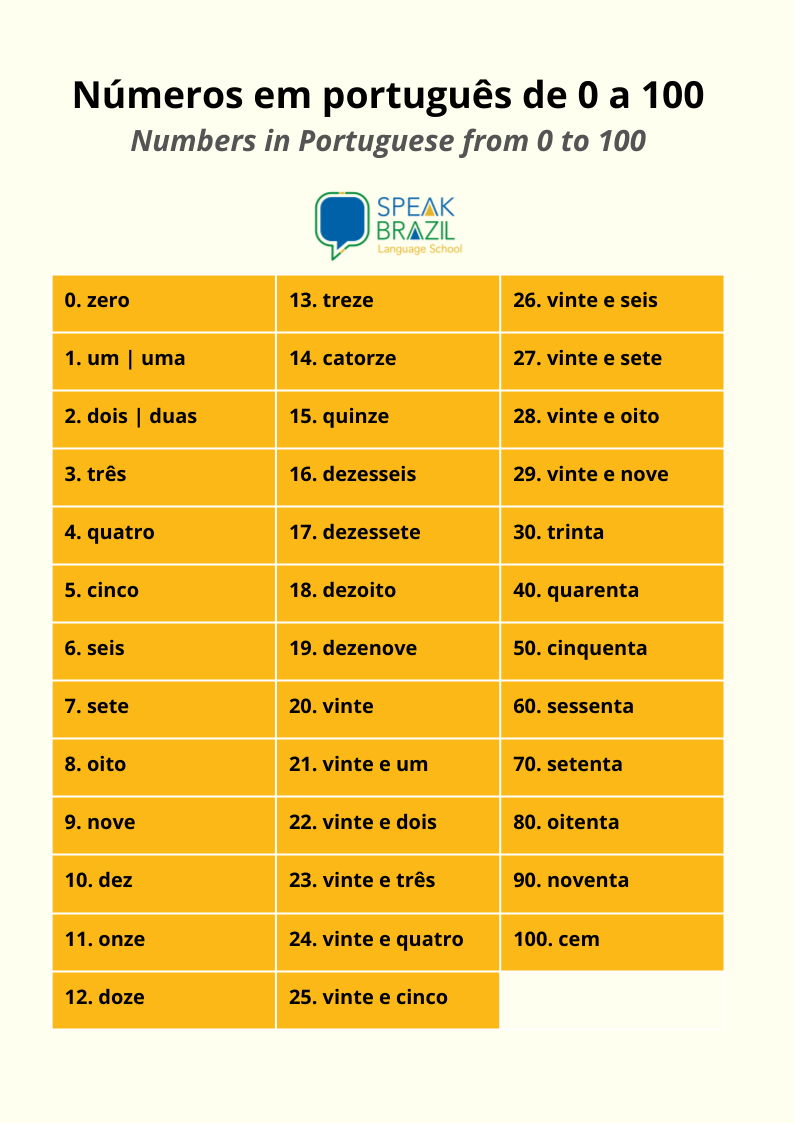
Read aloud the numbers from 0 to 100 in Portuguese, as follows:
Atenção! (Please note!)
Em português, os números 1 (um) e 2 (dois) têm formas masculinas e femininas, que mudam dependendo do substantivo que modificam. (In Portuguese, the numbers 1 and 2 have both masculine and feminine forms, which change depending on the noun they modify.)
Por exemplo, dizemos “um livro” porque “livro” é um substantivo masculino. Mas dizemos “uma cadeira” porque “cadeira” é um substantivo feminino. (For example, we say ‘um livro’ because “livro” is a masculine noun in Portuguese. But we say ‘uma cadeira’ because ‘cadeira’ is a feminine noun in Portuguese.)
O mesmo se aplica ao número 2: “dois carros” usa-se a forma masculina, enquanto “duas casas” usa-se a forma feminina. (The same applies to the number 2: “dois carros” (two cars) uses the masculine form, while “duas casas” (two houses) uses the feminine form.)
Número 1: (number 1)
- Masculino: um (masculine: one)
- Feminino: uma (feminine: one)
👉 Exemplos: (examples:)
- um livro (livro = masculino) (one book (book = masculine))
- uma cadeira (cadeira = feminino) (one chair (chair = feminine))
Número 2: (number 2)
- Masculino: dois (masculine: two)
- Feminino: duas (feminine: two)
👉 Exemplos: (examples:)
- dois carros (carros = masculino plural) (two cars (car = masculine))
- duas casas (casas = feminino plural) (two houses (house = feminine)
Regrinha simples (simple rule)
- Se o substantivo é masculino, use um e dois. (If the noun is masculine, use “um” and “dois”.)
- Se o substantivo é feminino, use uma e duas. (If the noun is feminine, use “uma” and “duas”.)
E quando os números 1 e 2 não estão acompanhados de uma palavra (um substantivo), vamos usar a forma masculina. Então, para contar os números, vamos dizer: um, dois, três… dez… (And when the numbers 1 and 2 are not accompanied by a word (a noun), we use the masculine form. So, to count the numbers, we say: “um, dois, três… dez”…)
– Eu tenho trinta e oito (38) anos. E você? Quantos anos você tem? (– I ‘m 38 years old. How about you? How old are you?)
– Eu tenho __ anos. (- I ‘m __ years old.)
Let's go practice?
Vamos Praticar?
Agora é sua vez de colocar em prática os números! (Now it’s your turn to practise with the numbers in Portuguese!)
1. Fale em voz alta e escreva os seguintes números: (Say the following numbers aloud and write them down:)
1, 2, 3, 4, 5, 6, 7, 8, 9, 10:
11, 12, 13, 14, 15, 16, 17, 18, 19:
20, 30, 40, 50, 60, 70, 80, 90, 100:
Confira as respostas no final desse artigo! (Check out the answers at the end of this article!)
Six vs Half - What is the difference and when do we use them?
Sabemos que no português brasileiro em algumas situações introduzimos a palavra “meia” como mais uma opção para se referir ao número “seis”. E também por causa da pronúncia, muitas vezes a pronúncia do número seis se confunde com a pronúncia do número “três”, e nessas situações, com certeza vamos usar a palavra “meia” para esclarecer que se trata do número 6 e não 3. (We know that in Brazilian Portuguese, in some situations we introduce the word ‘half’ as another option to refer to the number ‘six’. Also, because of pronunciation, the pronunciation of the number six is often confused with the pronunciation of the number ‘three’, and in these situations, we will certainly use the word ‘meia’ to clarify that it is the number 6 and not 3.)
Usamos a palavra “meia” para se referir a 6 nas seguintes situações: (We use the word ‘half’ to refer to 6 in the following situations:)
📱Número de telefone ou celular: 99669 – 2763 (podemos dizer: nove | nove meia | meia nove – dois sete | meia três) (Phone or mobile number: 99669 – 2763 (we can say: nine | nine half | half nine – two seven | half three))
🏡Número da minha casa: nº: 166 (podemos dizer: um meia meia) (My house number: no. 166 (we can say: one half half)
🚘Placa do carro: RIO 2A68 (podemos dizer: rio dois á meia oito) (Car registration: RIO 2A68 (we can say: rio two half eight))
🥚Ovos: 6 ovos (podemos dizer: meia dúzia) Eggs: 6 eggs (we can say: half a dozen)
Vamos continuar aprendendo os números em português! Força! (Let’s continue learning numbers in Portuguese! Go for it!)
Notice how there’s even a special word (“meia”) just to avoid confusion between “seis” (six) and “três” (three)? This shows how attuned the Brazilian ear is to subtle sound differences — and that’s exactly the kind of listening skill that makes all the difference when understanding a Brazilian speaking fast in everyday life. If you want to develop that same “trained ear“, check out Afine o Ouvido.
How do you say the numbers from 100 to 199 in Portuguese?
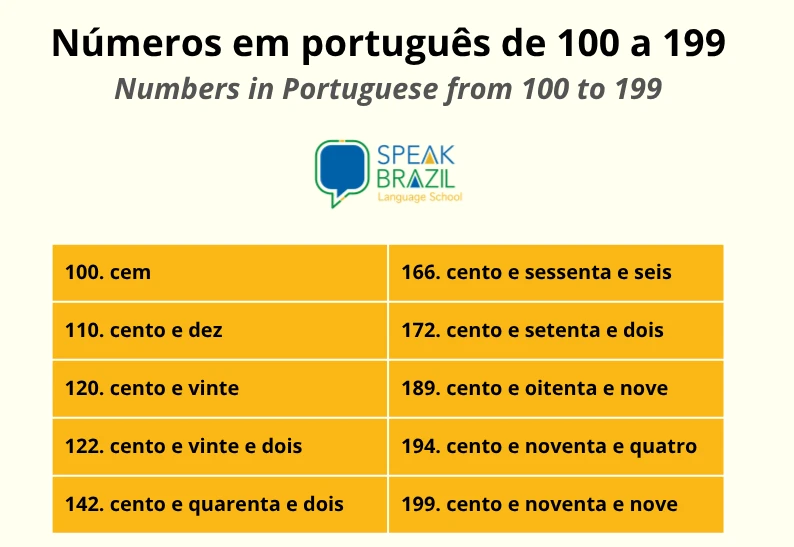
Listen to the audio and repeat the numbers out loud!
Agora vamos praticar esses números? (Now let’s practise these numbers in Brazilian Portuguese!)
2. Leia os números e escreva: (Read the numbers in Portuguese and write:)
cento e dez → ______
cento e vinte e cinco → ______
cento e trinta e nove → ______
cem → ______
cento e oitenta e três → ______
3. Verdadeiro (V) ou Falso (f): (true or false)
100 = cento. ( ___ )
120 = cento e vinte. ( ___ )
155 = cento e cinquenta e cinco. ( ___ )
199 = cem e noventa e nove. ( ___ )
110 = cento e onze. ( ___ )
Confira as respostas no final desse artigo! (Check out the answers at the end of this article!)
Cem vs Cento? One hundred
👉 “Cem”: usamos quando o número termina exatamente em 100.
(‘One hundred’: we use this when the number ends exactly in 100.)
Exemplos: (examples:)
Eu tenho cem reais. (I have one hundred reais.)
Ele tem cem livros de literatura. (He has one hundred literature books.)
👉 “Cento”: usamos quando o número continua depois de 100. (‘Cento’: we use this when the number continues after 100.)
Exemplos: (examples:)
- Eu tenho cento e dez reais na carteira. (I have one hundred and ten reais in my wallet.)
- Ele tem cento e vinte e cinco livros de contos em português como língua estrangeira. (He has one hundred and twenty-five short story books in Portuguese as a foreign language..)
✨ Dica para lembrar! (Tip to remember!)
- 💯Se for só 100 → cem. (If it’s just 100 → cem.)
- ➕💯Se for 100 e mais alguma coisa → cento. (If it’s 100 and something else → cento.)
3. Numbers in Portuguese from 100 to 1000
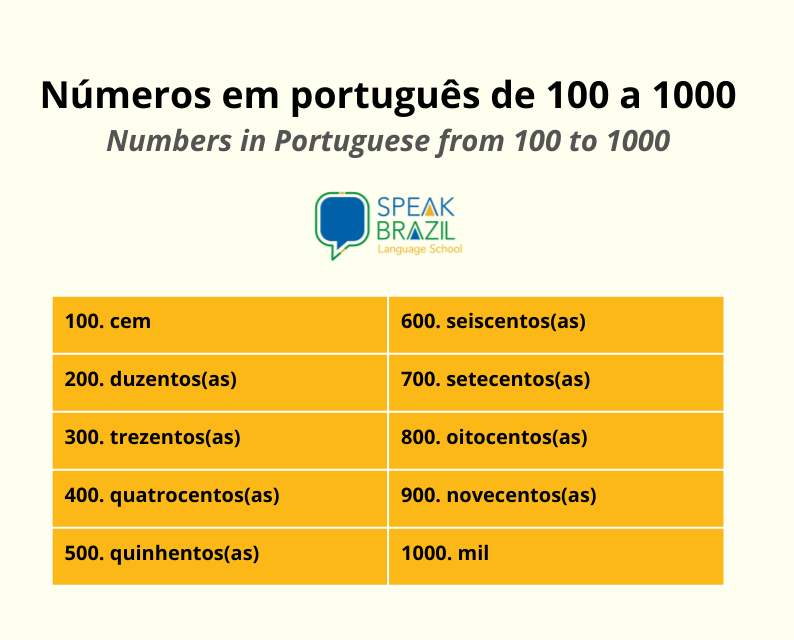
Listen to the audio and repeat the numbers out loud!
Vamos Praticar? Let's practise?
4. Associe o número ao nome: (Match the number to the name:)
110 → ( ) quinhentos
250 → ( ) cento e dez
700 → ( ) novecentos e vinte e três
500 → ( ) setecentos
499 → ( ) oitocentos e vinte e três
654 → ( ) duzentos e cinquenta
823 → ( ) quatrocentos e noventa e nove
945 → ( ) trezentos e dezesseis
316 → ( ) seiscentos e cinquenta e quatro
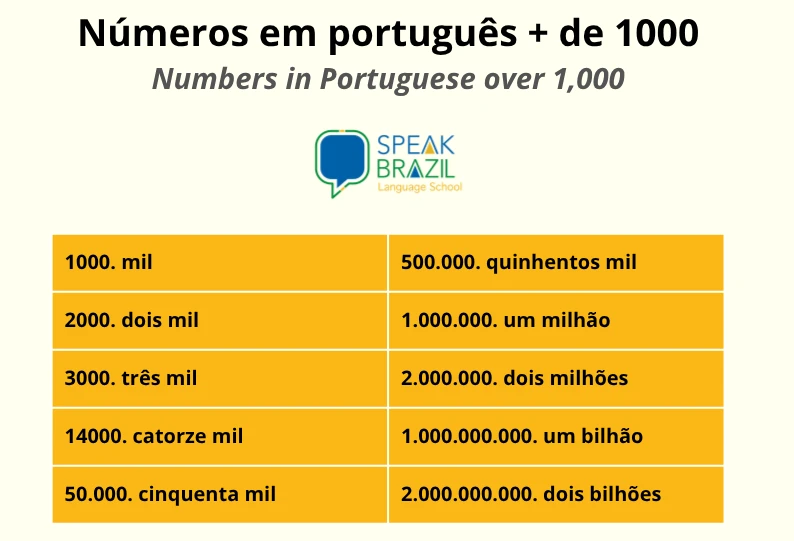
Listen to the audio and repeat the numbers out loud!
Numbers in Portuguese + over 1000
When should you insert an ‘e’ between numbers in Portuguese?
➡️A conjunção “e” é utilizada entre: (The conjunction ‘and’ is used between:)
🟡 dezenas e unidades – centenas e dezenas (tens and units – hundreds and tens)
Exemplos: (examples:)
→ 23: vinte e três / 223 duzentos e vinte e três (twenty-three / two hundred and twenty-three)
🟢 milhares e unidades (thousands and units)
Exemplos: (examples:)
→ 1009: mil e nove (one thousand and nine)
→ 3004: três mil e quatro (three thousand and four)
🟡 milhares e dezenas (thousands and tens)
Exemplos: (examples:)
→ 10.010: dez mil e dez (ten thousand and ten)
→ 1035: mil e trinta e cinco (one thousand and thirty-five)
- 🟢 milhares e os números 100, 200, 300, 400, 500, 600, 700, 800, 900. (thousands and the numbers 100, 200, 300, 400, 500, 600, 700, 800, 900.)
→ 1100: mil e cem (one thousand one hundred)
→ 2200: dois mil e duzentos (two thousand two hundred)
→ 11.400: onze mil e quatrocentos (eleven thousand four hundred)
→ 15.600: quinze mil e seiscentos (fifteen thousand six hundred)
When do we not use the conjunction ‘e’ when speaking the numbers in Portuguese?
Entre milhares e os números depois de 100, 200, 300, 400, 500, 600, 700, 800, 900. (Between thousands and numbers after 100, 200, 300, 400, 500, 600, 700, 800, 900.)
Exemplos: (examples:)
1100. mil e cem | 1111. mil (-) cento e onze |
1200. mil e duzentos | 1203. mil duzentos e três |
1300. mil e trezentos | 1366. mil trezentos e sessenta e seis |
1400. mil e quatrocentos | 1405. mil quatrocentos e cinco |
1500. mil e quinhentos | 1574. mil quinhentos e setenta e quatro |
Desafio! (Challenge!)
Fale o número da população do Brasil de 2025 em voz alta! (Say the population of Brazil in 2025 out loud!)
Vamos lá? (Let’s go?)
🇧🇷 🟢🟡população do Brasil (population of Brazil)
🗣️213.421.037: duzentos e treze milhões, quatrocentos e vinte e um mil, e trinta e sete pessoas
(two hundred and thirteen million, four hundred and twenty-one thousand, thirty-seven people)
🎧 And what if it were a Brazilian saying that number fast, without pausing between words? Reading numbers in Portuguese is a great first step. But listening to and understanding those numbers spoken naturally by a Brazilian — in real conversations, without pauses — is a completely different skill! Afine o Ouvido was made exactly for that: 👉🏾 training your ear with real audio of everyday spoken Brazilian Portuguese. Click the button below to find out more.
Saying phone numbers in Portuguese:
Vamos começar pelo número de celular: (Let’s start with mobile numbers:)
Todo celular no Brasil começa com o número 9 (nove). Vamos ver um exemplo: (All mobile numbers in Brazil begin with the number 9 (nine). Let’s look at an example:)
Podemos dizer o número de celular de várias maneiras: (We can say the mobile number in several ways:)
→ 9 8144-2358:
- nove, oito um, quatro quatro – dois três, cinco oito;
- nove, oitenta e um, quarenta e quatro – vinte e três, cinquenta e oito;
- nove, oito um, quatro quatro – vinte e três, cinquenta e oito;
- nove, oitenta e um, quarenta e quatro – dois três, cinco oito
Existem alguns números que são feitos para receber ligações gratuitas; estes números sempre começam com 0800. (Some numbers in Portuguese are designed to receive free calls, and these numbers always begin with 0800.)
Vamos ler da seguinte maneira: (Let’s read them as follows:)
→ 0800 200 211:
- zero oitocentos, duzentos, duzentos e onze;
- zero oitocentos, dois zero zero, dois um um.
Observação! Vamos falar sobre DDD e DDI. (Note! Let’s talk about DDD and DDI.)
A sigla DDD (discagem direta à distância): significa o número de dois dígitos que identifica cada estado do Brasil (The acronym DDD (direct distance dialling) refers to the two-digit number that identifies each state in Brazil.)
Exemplos: (examples:)
- DDD de São Paulo é 11 (The DDD for São Paulo is 11.)
- DDD do Rio de Janeiro é 21 (The DDD for Rio de Janeiro is 21.)
E a sigla DDI (discagem direta internacional): significa o número usado para identificar cada país (The acronym DDI (direct international dialling) refers to the number used to identify each country.)
Exemplos: (examples:)
- DDI do Brasil: +55 (DDI for Brazil: +55)
- DDI da França: +33 (France’s IDD: +33)
- DDI dos Estados Unidos: +1 (The United States’ IDD: +1)
Numbers in Portuguese: How to Use the Most Common Units of Measurement When Shopping
→ dúzia: uma duzia de ovos; meia dúzia de ovos (dozen: a dozen eggs; half a dozen eggs)
→ quilo ou quilograma: um quilo de banana (kilo: a kilo of bananas)
→ gramas: duzentos gramas de queijo (grams: two hundred grams of cheese)
→ molho: um molho de salsinha (sauce: a sauce of parsley)
Points and commas between numbers in Brazilian Portuguese
É comum em português, lermos os números com vírgulas da seguinte maneira: (In Portuguese, it is common to read numbers with commas as follows:)
→ 96,3%: noventa e seis vírgula três porcento (96.3%: ninety-six point three per cent)
→ 99,9%: noventa e nove vírgula nove porcento (99.9%: ninety-nine point nine per cent)
Vamos pronunciar o sinal (,) como vírgula! (Let’s pronounce the symbol (,) as a comma!)
Multiples in Portuguese: Commonly Used in Everyday Conversation
Os múltiplos mais usados no dia a dia em português são: (The multiples most commonly used in everyday Portuguese are:)
→ dobro: (double:)
O preço do quilo do abacaxi está custando o dobro do preço! (The price per kilo of pineapple is double what it used to be!)
→ triplo: (triple:)
Este ano vou pagar o triplo passagem aérea do que paguei no ano passado. (This year I’m going to pay triple what I paid last year for my plane ticket.)
Fractions in Portuguese: The Most Commonly Used in Everyday Life
→ meio/meia (como numeral = metade): (meio/meia (as a numeral = half))
- Bebi meio copo de caipirinha. (I drank half a glass of caipirinha.)
- Ela comprou meia melancia. (She bought half a watermelon.)
→ um terço: (a third)
- Adicione um terço de leite coco na tapioca granulada. (Add a third of coconut milk to the granulated tapioca.)
→ um quarto: (a quarter)
- Acho que falta um quarto da casa para limpar, mais uma hora e eu termino tudo. (I think there’s a quarter of the house left to clean, another hour and I’ll be done.)
Names of years in Portuguese
Como você falaria esse número em português: 2026? (How would you say this number in Portuguese: 2026?)
a. vinte, vinte e cinco
b. dois zero dois cinco
c. dois mil e vinte e cinco
Muito bem, se você escolheu a letra c! E seria muito mais fácil se em português falássemos a letra a! (Very good, if you chose letter c! And it would be much easier if we used letter a in Portuguese!)
Agora vamos ler os números dos anos em voz alta para praticar! (Now let’s read the numbers of years aloud to practice!)
- 1822: mil oitocentos e vinte e dois
- 1888: mil oitocentos e oitenta e oito
- 1930: mil novecentos e trinta
- 1985: mil novecentos e oitenta e cinco
- 2000: dois mil
- 2026: dois mil e vinte e seis
✨Wow, you’ve made it to the end — what an amazing achievement! Now you already know the numbers in Brazilian Portuguese.
Numbers are just the start. Ready to practise it all?
👉Brazilian Portuguese exercises!

👀Se você quiser continuar aprendendo mais português! (Want to keep learning Portuguese language!) 😊
Confira esses outros artigos do blog relacionados a listas de verbos regulares e irregulares em português: (Check out these other blog articles related to lists of regular and irregular verbs in Portuguese:)
Aproveite os comentários para escrever e fazer os exercícios em português!!! Vou adorar corrigir e ver sua evolução! (Take advantage of the comments to write and do the exercises in Portuguese!!! I will love to correct them and see your progress!)
1. Fale em voz alta e escreva os seguintes números: (Say the following numbers aloud and write them down:)
-
1, 2, 3, 4, 5, 6, 7, 8, 9, 10: um, dois, três, quatro, cinco, seis, sete, oito, nove, dez
-
11, 12, 13, 14, 15, 16, 17, 18, 19: onze, doze, treze, catorze, quinze, dezesseis, dezessete, dezoito, dezenove
-
20, 30, 40, 50, 60, 70, 80, 90, 100: vinte, trinta, quarenta, cinquenta, sessenta, setenta, oitenta, noventa, cem
2. Leia os números e escreva: (Read the numbers in Portuguese and write:)
-
cento e dez → 110
-
cento e vinte e cinco → 125
-
cento e trinta e nove → 139
-
cem → 100
-
cento e oitenta e três → 183
3. Verdadeiro (V) ou Falso (f): (true or false)
-
100 = cento. ( V )
-
120 = cento e vinte. ( V )
-
155 = cento e cinquenta e cinco. ( V )
-
199 = cem e noventa e nove. ( F )
-
110 = cento e onze. ( F )
4. Associe o número ao nome: (Match the number to the name:)
-
110 → (4) quinhentos
-
250 → (1) cento e dez
-
700 → (8) novecentos e vinte e três
-
500 → (3) setecentos
-
499 → (7) oitocentos e vinte e três
-
654 → (2) duzentos e cinquenta
-
823 → (5) quatrocentos e noventa e nove
-
945 → (9) trezentos e dezesseis
-
316 → (6) seiscentos e cinquenta e quatro
👀I’m so happy to be part of your journey! If this content helped you learn and practice, you can make a small donation by clicking the button below! Thank you! ✨☕😃👇✨